A077 最新 Commun Psych | 从眼动中解码记忆: 你的眼睛,比你的嘴更“诚实”地记得
来源:公众号 PSY-Brain_Frontier | 发布:2025-09-27 | 原文链接

点击蓝字 关注我们 知晓前沿
认知神经科学前沿文献分享

基本信息
Title:Anticipatory eye gaze as a marker of memory
发表时间:2025.8.11
Journal: Communications Psychology
影响因子:暂无(此期刊2023年新创办,作为著名出版集团自然(Nature Portfolio)旗下“Communications”系列期刊的一员,该期刊致力于发表心理学所有领域的原创性研究)
原文链接:后台回复“我要文献”/“文献”即可获取文献PDF版本


研究背景
“话到嘴边却忘了”,这种体验人人都有。但这背后隐藏着一个困扰记忆科学家长达一个世纪的难题:一个无法被言语清晰表达的记忆,还算是记忆吗?

传统记忆研究极度依赖口头或书面报告,但这不可避免地混淆了“记忆本身”与“提取并报告记忆的能力”。对于无法清晰进行语言沟通的婴幼儿、中风后的失语症患者,或是在跨物种的动物研究中,这一局限尤为突出,使我们难以窥探记忆的真实面貌。
那么,我们能否绕开语言这道屏障,找到一扇能直视记忆的生理学窗口?近期发表于Nature子刊《Communications Psychology》上的一项突破性研究表明,这扇窗户,或许就是我们的眼睛。
省流总结
以色列特拉维夫大学的研究团队开发了一种名为 “记忆事件凝视预期”(Memory Episode Gaze Anticipation, MEGA)的无报告范式(no-report paradigm),通过追踪眼动来客观、量化地评估记忆。
核心范式
研究人员让被试两次观看包含特定“意外事件”(Surprising Event, SE)的影片。核心发现是,在第二次观看时,即使事件尚未发生,被试的目光也会无意识地、提前数秒汇聚到事件将要发生的位置。这种“预期性凝视”(anticipatory gaze)构成了记忆存在的客观生理指标。
关键发现
- 客观量化记忆: 研究者定义了“凝视平均距离”(Gaze Average Distance, GAD)这一指标,即凝视点与未来事件发生位置的平均欧几里得距离。在第二次观看时,GAD的显著降低,成为了一个稳健、可量化的记忆痕迹指标。该效应在五项独立实验、多种影片类型(包括定制动画与真实的自然影片)中得到了一致验证。
- 分离“回忆”与“熟悉”: 该研究首次在生理层面清晰地分离了两种核心记忆过程。预期性凝视(GAD的变化)被证实特异性地标记了对事件“内容-地点”的“情景性回忆”(recollection);而瞳孔扩张(pupil dilation)则更多地反映了对场景的“熟悉度”(familiarity),为这两种记忆系统的独立性提供了强有力的无报告证据。
- 超高的检测灵敏度: MEGA范式的灵敏度远超传统口头报告。它不仅能探测到被试自己都声称“没见过”的影片的记忆痕迹(即无意识记忆),还成功检测到了午睡对记忆巩固的微小助益——而这一效应在口头报告的统计中并未显现。
核心意义
MEGA范式为记忆研究提供了一个绕开语言报告的、客观、量化且高度敏感的新工具。它不仅为认知神经科学的基础研究(如分离记忆与意识报告的神经机制)开辟了新路径,也为临床应用(如失语症患者的记忆评估、阿尔茨海默病等神经退行性疾病的早期非言语诊断)带来了巨大的想象空间和应用潜力。
核心图片
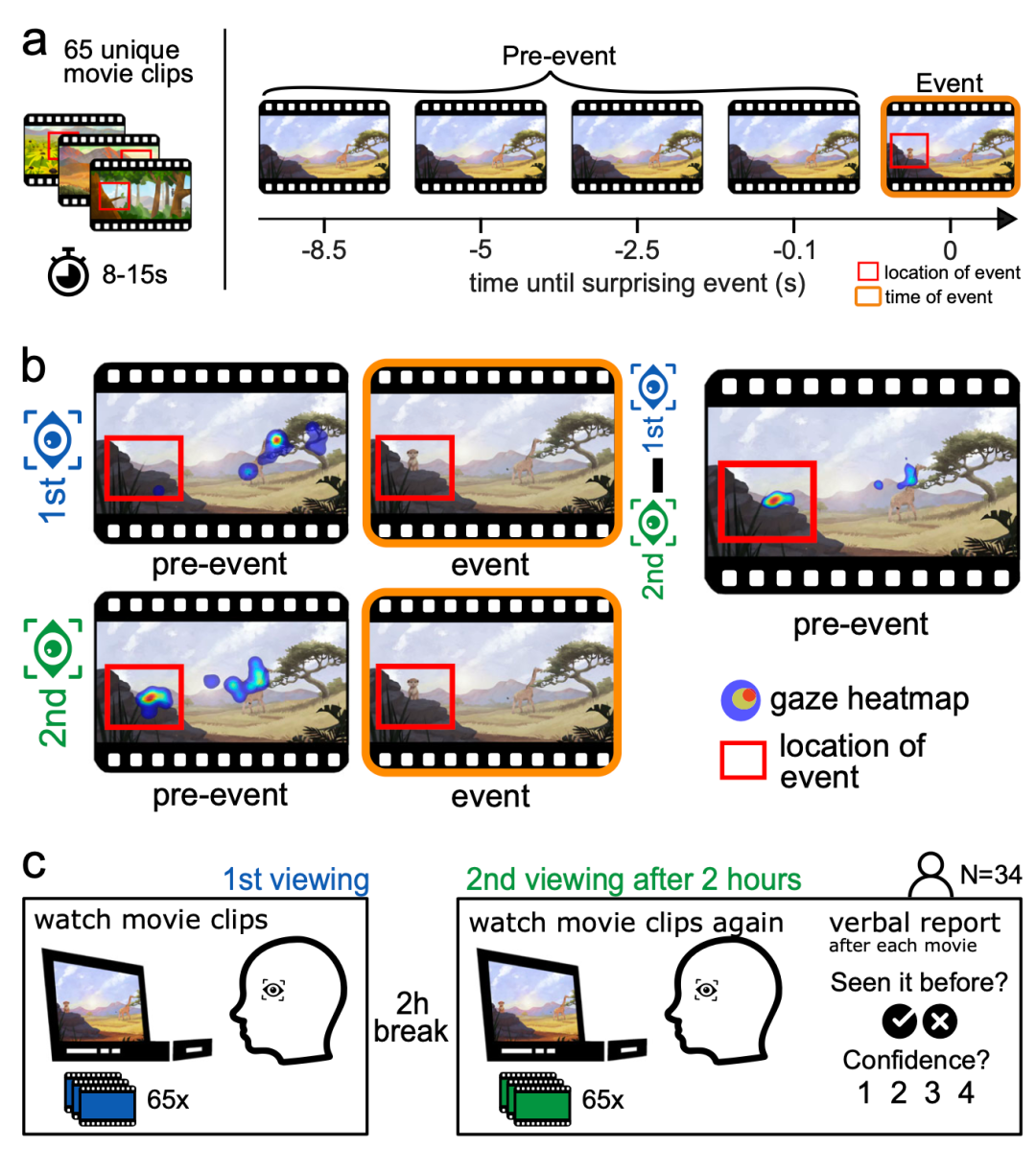
Fig. 1 | MEGA paradigm.
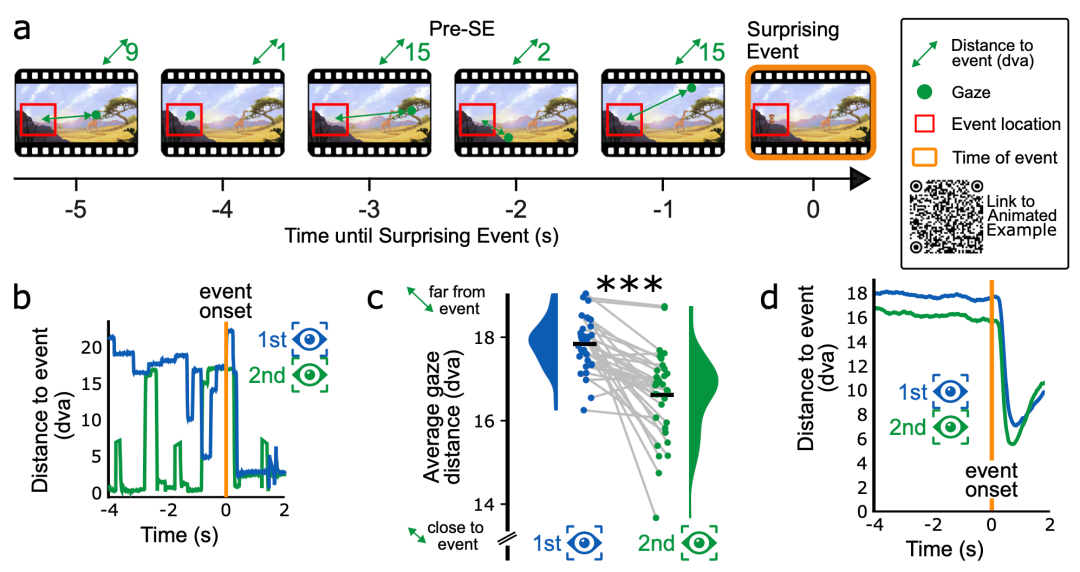
Fig. 2 | Anticipatory gaze effect.

Fig. 3 | Single-trial predictive modeling using machine learning of eye tracking data features.

Fig. 4 | The relationship between anticipatory gaze and explicit memory reports.

Fig. 5 | The anticipatory gaze effect is replicated in naturalistic (YouTube) videos.

Fig. 6 | MEGA scores improve after sleep compared to wakeful rest.

Abstract
Human memory is typically studied by direct questioning, and the recollection of events is investigated through verbal reports. Thus, current research confounds memory per-se with its report. Critically, the ability to investigate memory retrieval in populations with deficient verbal ability is limited. Here, using the MEGA (Memory Episode Gaze Anticipation) paradigm, we show that monitoring anticipatory gaze using eye tracking can quantify memory retrieval without verbal report. Upon repeated viewing of movie clips, eye gaze patterns anticipating salient events can quantify their memory traces seconds before these events appear on the screen. A series of five experiments with a total of 145 participants using either tailor-made animations or naturalistic movies consistently reveal that accumulated gaze proximity to the event can index memory. Machine learning-based classification can identify whether a given viewing is associated with memory for the event based on single-trial data of gaze features. Detailed comparison to verbal reports establishes that anticipatory gaze marks recollection of associative memory about the event, whereas pupil dilation captures familiarity. Finally, anticipatory gaze reveals beneficial effects of sleep on memory retrieval without verbal report, illustrating its broad applicability across cognitive research and clinical domains.

本文解读基于:Anticipatory eye gaze as a marker of memory,Doi: 10.1038/s44271-025-00305-7 IF: NA NA NA。核心图表、方法细节、统计结果与讨论见原文及其拓展数据。点击左下角 “阅读原文” 可跳转到论文源网站界面。
分享人:饭哥
审核:PsyBrain 脑心前沿编辑部
PsyBrain 脑心前沿
带你了解心理学、脑科学的前沿知识与技术流程
预览时标签不可点
阅读原文
不喜欢
微信扫一扫
关注该公众号
知道了
微信扫一扫
使用小程序
取消 允许
取消 允许
取消 允许
× 分析

微信扫一扫可打开此内容,
使用完整服务